Applied Learning Programme (ALP)
Applied Learning Programme (ALP)
Vision and mission of ECO@CKP Applied Learning Programme

In nurturing our students to become Learners with Passion, Citizens of Honour, we believe that when our students learn and acquire knowledge, it not only enriches their own lives but also influences those around them and positively impacts their communities. With that belief, our school’s Applied Learning Programme (ALP), ECO@CKP, aims to nurture students as eco-stewards who care for the environment, advocate sustainable habits, and solve environmental challenges with their computational skills.
Initiated in 2019, ECO@CKP integrates design thinking into environmental education where students develop practical solutions to environmental problems with technology and cultivate emerging 21st century skills such as critical thinking and adaptability in students. They learn to approach complex problems with creativity, empathy, and resilience, empowering them to become effective problem solvers in the pursuit of a more sustainable future.
Students will then apply these skills they learnt in the implementation of their Project Work (PW), which is the end-product of the ALP.
We believe in a spiral approach where students will revisit the same topics every year, with each encounter increasing in complexity and reinforcing previous learning.
Tier-1 programme (school-wide)
Level 1 : Exposure to Basic Coding
P1
ALP Lessons
Awbie coding
Project Work
Students have their first experience in coding using the physical coding blocks to control the movement in the game character Awbie. Through playing Awbie coding game, students learn basic sequential programming and basic repeat loops, which set the foundation of coding from Primary 2 onwards.
ALP Lessons
Creating a Google Slide
Project Work
Students learn the various functionalities of Google Slides and then exposed to the sustainability topic on “3Rs and upcycling”. They are then tasked to create a simple presentation using Google Slide to promote 3Rs and upcycling.
P2
ALP Lessons
Exposure to Scratch 3.0 programming (Making an animation)
Project Work
Students learn block coding in Scratch platform and then exposed to the sustainability topic on “Climate Change”. They are then tasked to create a Scratch interactive animation to promote awareness of climate change.
Level 2: Basic / Intermediate / Advanced Coding
P3
ALP Lessons
EcoCoders: Small Steps, Big Change Micro:bit (Basic)
Project Work
Students undergo the learning of the 4Rs in Sustainability. They would be creating Eco-enzymes from food waste. Students would create a sequence/programme/display though Micro:bit programme to set timely reminders while creating their Eco-enzymes.
P4
ALP Lessons
Micro:bit (Intermediate)
Project Work
Students draw relevant and authentic links on electricity and water wastage in schools and homes. They then create a Micro:bit prototype to solve problems related to electricity or water wastage. Students have the opportunity to try out their prototypes for their feasibility in implementing them.
P5
ALP Lessons
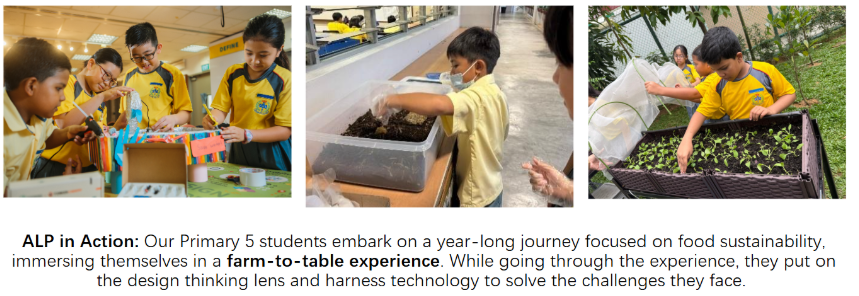
From farm-to-table: An Urban Farmer’s Journey Micro:bit (Advanced)
Project Work
Students undergo the experience of harvesting vermicompost from our Wormery. They repurpose food waste as way to feed the worms. The harvested vermicompost are used as natural fertilizers in our Edible Garden; where students grow vegetables and track their growth. With their physical experiences in the Wormery and Edible Garden, students create a Micro:bit prototype to solve problems faced during their wormery and edible gardening phase.
Tier-2 programme
Tech Club CCA
Activities
In-depth coding projects using various coding platforms such as Scratch, Micro:Bit, etc
Participation in coding competitions
No. of lessons
2 hours every CCA week